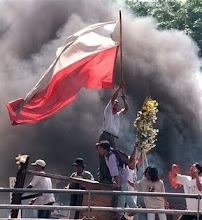
(Message to the League of Filipino Students)
By Jose Maria Sison
Chairperson, International League of Peoples' Struggle
Founding Chairman, Kabataang Makabayan
September 11, 2009
It is always an honor and privilege for me to convey warmest greetings
of solidarity to the national officers, general membership and all
chapters of the League of Filipino Students (LFS) on the occasion of its
founding anniversary today.
As requested, I am glad to update you briefly on the crisis of
imperialism in the economic, political, military and cultural fields,
assess the impact of such crisis on the semicolonial and semifeudal
ruling system in the Philippines and challenge the LFS and entire
student youth to continue advancing the struggle for national democracy.
Crisis of Imperialism
The current crisis of imperialism is as grave as the Great Depression of
the 1930s and is on the way to becoming worse in its scope, depth and
duration. It is the result of an ever worsening crisis of overproduction
and the constant drive of the monopoly bourgeoisie to extract
superprofits and overaccumulate capital.
The economic and financial crisis is certain to deepen and worsen as the
imperialist powers are driven to further exploit the working people and
plunder the underdeveloped countries. Even as they continue to spout the
slogan of ?free market? globalization, the imperialist powers
increasingly become protectionist and scramble for sources of cheap raw
materials, captive markets, fields of investment and spheres of influence.
Political crisis and disorder are spreading and intensifying on a global
scale. The imperialist powers headed by the US use the slogan of
anti-terrorism in generating wars of aggression, state terrorism,
fascism, chauvinism, racism, religious bigotry and other forms of
barbarism. But the working class and the broad masses of the people are
waging various forms of resistance against imperialism and reaction and
for national liberation, democracy and socialism.
The US is the epicenter of the crisis of the world capitalist system and
is overextended due to its plundering and aggressive character. It is in
the process of losing its position as No. 1 imperialist power even as it
remains the No. 1 enemy of the people of the world. The increase in the
number of major capitalist powers due to the revisionist betrayal of
socialism has led to what is termed as multipolarity, a euphemism for
the intensifying inter-imperialist struggle for a redivision of the world.
The rise of new technology ought to improve socio-economic conditions,
expand the range of freedom and promote the cultural achievements of the
people. But in the imperialist system, the new technology has led to
increasingly severe crises of overproduction, to the further stifling of
freedom for the working people, to the cultural degradation and mass
deception, to unprecedented destructiveness of imperialist wars and to
the ruination of peoples and the environment.
Impact on the Philippine Ruling System
The semicolonial and semifeudal character of the Philippine ruling
system has been deepened and aggravated by the US-instigated policy of
free market? globalization and by the series of economic and financial
crises of the world capitalist system during the last three decades. The
current crisis of imperialism is further deepening and aggravating the
crisis of the domestic ruling system.
The Philippine economy is pre-industrial, agrarian and semifeudal in
character. Under trade liberalization, it has lost sufficiency in rice
and other types of food for domestic consumption because of dumping by
other countries. It is dependent on the export of raw materials and
re-export of low value-added semi-manufactures. Constant trade and
budgetary deficits have resulted in heavy foreign and domestic
borrowings every year. Under current crisis conditions, the economy
suffers from diminished foreign demand for its exports and re-exports
and from the tight global credit situation.
The Philippines is in a state of economic depression. Mass unemployment
has become far worse than ever before. The low wages of workers are
further being pressed down and so are the incomes of the middle social
strata. Landlords are demanding higher rent from tenants. Prices of
basic commodities are rising and so are the taxes and the service fees
charged by the reactionary state. Social unrest is therefore building up
and bursting out.
The Arroyo regime is hated by the people for its puppetry to imperialist
interests, its unbridled corruption and its gross and systematic
violation of human rights. It is extremely isolated and ripe for
overthrow by the broad united front and the broad masses of the people.
Fearful of losing power and facing demands for justice, it is exerting
all efforts to weaken and suppress the broad legal opposition and the
mass movement.
The struggle for power among the reactionary factions of the ruling
classes of big compradors and landlords is more bitter and violent than
ever before But the anti-Arroyo reactionary factions have for the moment
a preference for the electoral method of choosing which clique is next
in line to serve the imperialists and the local exploiting classes, to
get the lion's share of the spoils of office and suppress the resistance
of the people. At any rate, the basic problems of the people persist and
continues to strain the ability of the ruling system to contain them.
The Arroyo regime has been daydreaming that Oplan Bantay Laya, backed up
by US military intervention under the so-called Visiting Forces
Agreement, can destroy or reduce the revolutionary forces of the people
to inconsequentiality. Instead, the revolutionary forces of the people
have been growing in strength and advancing. The US imperialists and the
Arroyo regime seem to forget that not even the Marcos fascist
dictatorship and the presence of US military bases could destroy the
still limited strength of the armed revolutionary movement.
Challenge to the Filipino Student Youth
Today the Filipino student youth suffer fast deteriorating living and
study conditions. They face bleak prospects with regard to prompt and
proper employment even if they were to finish their courses of study.
They are constrained by conditions which victimize their parents and
themselves, especially if they come from the ranks of the working people
and lower and middle social strata. Within the present ruling system,
education is considered a commodity that is available only to those who
can pay for it.
The private schools are dominant in the market, particularly at the
secondary, vocational, tertiary and graduate levels. The public high
schools and the state colleges and universities are charging ever higher
tuition fees because the reactionary state does not appropriate enough
public funds for education but appropriates the most funds for the
servicing of the public debt, financing graft-ridden supply contracts
and boosting the military, police and intelligence services.
The Filipino student youth are victimized not only by the rising costs
of living and study but also by the content of education or miseducation
to which they are subjected. They are systematically diverted from
consciousness that is patriotic, scientific and people-oriented. Those
who control the educational system, the mass media and other
institutions seek to alienate them from the people's demand for national
independence, democracy, social justice, development and international
solidarity and peace against imperialism and all reaction.
The League of Filipino Students and the entire Filipino student youth
are more than ever challenged to arouse, organize and mobilize
themselves and join the rest of the Filipino people in continuing the
struggle for national liberation and democracy against foreign monopoly
capitalism, domestic feudalism and bureaucrat capitalism. We urge you to
exert all efforts at changing not only the US-directed Arroyo regime but
the entire rotten ruling system.
Our struggle must break the chains of our economic, social, political
and cultural captivity. We must uphold the national sovereignty of the
Filipino people, empower the working people in a new type of democracy,
develop the economy through national industrialization and land reform,
promote a national, scientific and democratic type of culture and
education and contribute to the building of a new and better world, free
from imperialism and all reaction.###
Jumat, 11 September 2009

Jumat, 04 September 2009
Interview with Comrade Binod
Comrades,
My thanks to you for this interview with Cdel Binod. The questions were not asked in a prescriptive, dogmatic sense but in an intelligent and comradely way, addressed the strategy of the UCPN(M) and elicited a cogent riposte to those armchair, karaoke Maoists who have second guessed the comrades on the ground.
I had the privilige to hear Cde. Prachanda recently in London and he confirmed that the Maobaadi are analysing the concrete conditions in Nepal and not engaged in some emotiional spasm based on 'sacred' texts.He cleary said that the task is not to copy the Russian or Chinese Revolutions to to develop their own strategy.
I have sponsored Cde Kiran and a comrade to come to the UK and, while there was a delay because the recent Central Committee took a month to achieve a synthesis of the contradictions of the two line stuggle (that was unique that in that it treated this debate among comrades in a non-antagonistic manner,) it is now likely that they will arrive withing two months.
Lal Salaam
Peter Tobin
PS Cde Guarev will also be coming I have been informed.
.
To: maoist_revolution@ yahoogroups. com; revolutionary_ diary@yahoogroup s.com
CC: republicanarmy@ yahoogroups. com
From: wprm_britain@ yahoo.co. uk
Date: Sun, 30 Aug 2009 06:26:37 -0700
Subject: [** MAOIST_REVOLUTION **] Nepal: Interview with Comrade Binod
Note: In the current situation, in which international support for the Nepalese revolution has waned considerably since 2006, members of WPRM (Britain and Ireland) are in Nepal to talk with leaders and masses to try to better understand the contradictions in Nepalese society and how the UCPN(M) is providing leadership in making revolution. We believe constructive criticism should be made on the platform of internationalist support, especially given the ongoing threat from US imperialist and Indian expansionist intervention. Here is the first of various interviews and articles we hope to publish.
------------ --------- --------- --------- --------- ---
WPRM: Can you introduce yourself please?
Com. Binod: My name is Comrade Binod. I am a Central Committee member and secretary of the state council for Mahakali state, which comprises seven districts in the far west of Nepal.
WPRM: Can you tell us about the recent Central Committee meeting and its implications for the coming weeks and months?
Com. Binod: In the life of the party, this Central Committee meeting has been unusual from the point of view of ideology and debate. We have received an opportunity, and we are proud that this meeting has been very unusual because it has taken place amid the deep curiosity of the proletariat in Nepal as well as the world over. This curiosity is positive. At the same time, the imperialists and reactionaries also have an expectation. Amid this we have carried out a great meeting, and made decisions which have made us proud to talk about this meeting.
WPRM: And what are these decisions?
Com. Binod: At this moment when there is no experience of revolution in the 21st century, when there is no advanced proletarian revolutionary movement in the world, when this country is encircled and governed by Indian expansionism, at this moment against imperialism and expansionism, we have come to the decision that we have to accomplish insurrection. This is the important outcome of this meeting.
WPRM: So insurrection can be carried out in this situation?
Com. Binod: Certainly there is a negative situation; an unfavourable situation for revolutionaries. But there is no other mightier force than the people, and the Nepalese people are so mighty. Because of this, these people can bring us success. We have the ideology of Marxism-Leninism- Maoism (MLM) and we have a good and clear organisational setup, we have a team of leaders who want to fight, we have a class, a nation and a region which has been heavily suppressed. We have the commitment to win victory, the commitment to synthesise our understanding to a new height. Certainly there are serious obstacles put in front of the Nepali people by the Americans, but we have commitment, courage and the confidence to overcome those obstacles. What we see now within the UML, a revisionist party, is that their cadres have lost confidence with their leaders and their line. At the same time within Nepali Congress, a reactionary party, many cadres have also lost confidence with their leaders and their line. The monarchists have already lost their leadership and also the Terai nationalist forces have seen their leadership divided.
We have a glorious history. You are British, and we have a glorious history of Ghorkali forces that defeated the British Army in many places. As descendants of that, our people are equipped with the weapons of MLM and the blood that is flowing in Nepal is now working for the purpose of socialism and communism. When we initiated the People’s War we were only 70 or 75 people. Even at that time we had the courage and confidence that we could conquer the world, that the revolutionary forces, the proletariat, could conquer the world. We had some fear about whether our party was going to be destroyed, or whether, like UML, it would become a revisionist party, whether it would vacillate on the revolutionary path. But through the process of great debate we have come to a higher level of understanding and we see that the victory of the proletariat is inevitable. We have a deep feeling that today no-one can make this party a reactionary or vacillating party. We are not only capable and experienced in leading People’s War but also in leading line struggle and taking the party to a higher level of debate. That has been proved in this meeting.
WPRM: How does the UCPN(M) feel about the current UML led coalition government?
Com. Binod: Our senior leader Baburam Bhattarai said that the Nepali people have given the responsibility of being a driver to the Maoists, as a conductor to the Nepali Congress and as a caretaker to the UML. But now the caretaker has taken the place of the driver and the driver is in place of the caretaker. In Nepalese tradition there is a fable about Dakchyaprajapati, who has the body of a human being and the head of a goat, which is set in a wrong direction, pointing backwards. This government is like that. Objectively we understand this government like that, but politically this government is designed by Nepali Congress. In the objective reality of Nepal, this government has been constructed in order to destroy the Nepali revolution, the UCPN(M) and the aspirations of the Nepali people. But this government is like a scarecrow. In the beginning the birds think this might be a man. Then when the bird realises this is not a man then it sits on the head of the scarecrow. At the moment this government is like a scarecrow. The Nepali people understand that it is set up by Indian expansionism and they are not afraid of this. So it is not so important to talk about this government, but as far as MK Nepal (the PM) is concerned, he has time and again over the last few years prepared his trousers and his daura-suruwal (a type of Nepali dress). He has been prepared many times but had never before had this opportunity. Now he has got his opportunity. But this time there is a big possibility that his chair will fall down before his clothes get dirty.
WPRM: Now Prachanda is talking about a new government being formed, how will this come about?
Com. Binod: This new government will assure civilian supremacy and national sovereignty, giving immediate relief to the people and with the purpose of insurrection. We have carried out many preparations in order to convince the international community that it is necessary to have power, in order to convince Nepalese society this government will be formed. Certainly, this government will be formed to organise insurrection, having convinced the international community that we want a new society, and to convince the revolutionary forces that we want to make revolution, to convince the people that we are going towards a new society, to convince anti-imperialist and anti-expansionist forces that we are taking this society forwards.
WPRM: How exactly will this new government come into being?
Com. Binod: The main basis is the Nepalese people. It will come about through the struggle of the Nepalese people, through strong intervention against the parliament and the organisation of a United Front amongst the nationalist and democratic forces within parliament and involving all sections of people and civil society. We understand that one section of UML is not happy with this government. The main section of the leadership is also not happy with this government. The Madhesi party has split and the Madhesi people are also not happy with this government. Even the honest people within Nepali Congress believe that without the Maoists the new constitution cannot be written. The people who are in favour of civilian supremacy and national sovereignty are also not happy with this government. The majority within this parliament agrees on the question that the step of the president (to overrule then-PM Prachanda’s decision to sack General Katuwal) is unconstitutional and unjust. These parliamentary forces are afraid even to debate this issue, this motion on the step of the president. Therefore this government is defunct because the practice has been shown that the parties are split and the parliamentary members are protesting. This kind of government cannot be accepted for a long time. It is defunct and is losing morality, confidence and honesty. It is set up against the people and so cannot sustain itself for long time.
WPRM: The deadline for writing the constitution is in nine months, is it possible to write it in time and what will happen if it is not?
Com. Binod: The constitution would certainly have been written if there was no struggle between opposite classes. But this struggle is happening as a political struggle. The other classes would like to write a constitution according to their class interests, we would like to write a constitution according to our class interests. The possibility of the constitution being written is low. At that time there is the possibility that a new class situation might emerge. We are taking the issue very seriously in order to meet the challenges that might come up in those conditions. In this situation we are trying to organise the masses for rebellion, through insurrection of the masses. The reactionaries didn’t want Constituent Assembly elections, but on the backs of the masses they were obliged to hold them. They didn’t want a republic, but on the back of the people the republic was established. Those elements who once put a bounty on our heads and propagated that we are terrorists have now been forced to recognise us as a political party because of the force of the people, as has the US imperialist force who also called us terrorists.
No such event has before taken place in history, where ‘terrorists’ have been recognised like this. These kind of unimaginable things have happened on the back of the force of the masses. We believe that on the back of the force of the masses, the constitution can also be written, a constitution favourable to the masses, but the possibility of that kind of constitution being written is very low at the moment.
WPRM: Many Maoists around the world are concerned that the party has given up the armed struggle, the PLA are in cantonments and the party now has the plan to merge the two armies together, the PLA and the Nepali Army (NA). What is the role of the PLA now in the struggle for revolution in Nepal?
Com. Binod: The PLA is under the control of UNMIN and a special team, the Army Integration Committee. But practically the PLA is under the control of the Maoist party. Even though the weapons are in containers, the key of those containers is in our hands. We talked to the lower members of the NA and we found that the behaviour within their army is like from the 12th or 14th centuries, feudal behaviour is being carried out. The leadership of the NA is from a very backward class, from feudal leadership. If we do things carefully then there is a big possibility that the bitterness between officers and soldiers could be maximised. Obviously as long as the NA is around, insurrection or victory cannot be achieved. Hence, the question of integration is not that the PLA is being diluted into the NA. The NA should be diluted into the PLA. The meaning of the policy of army integration is not in the dissolution of the PLA but in the dissolution of the NA, to transform the NA and turn it into a PLA. That is why Nepali Congress and UML are always afraid of army integration.
WPRM: Mao said that after 1949 the dangers of sugar-coated bullets are more dangerous than the real bullets from the war before. How does the UCPN(M) understand this?
Com. Binod: Certainly this situation is grave, but it is not out of our hands and the situation can be made positive. Why has the situation developed in the world where millions of people worked to establish a socialist state and then again the same people came to power and later removed that state away. Why is that? Why do the same people who were once deeply respected reach the point of denouncing the state? There are still certain citizens who fought for Marxism who are now really afraid of Marxism. While we were talking to youth from Eastern Europe, youth working for human rights organisations, I talked to them and asked why there is no attraction towards Marxism among the masses of Eastern European countries.
Why do British people, where Marx said the first revolution would take place, still support the rejected parliamentary system? Why was the Chinese revolution demolished very easily after the death of Mao Zedong? We have to answer these crucial questions standing on the unprecedented history of the 21st century. We feel we can meet the many challenges put forward in the present world. We will continue developing our understanding, our theory, having in the present given answer to these questions; these crucial questions. Based on dialectical materialism and based on democratic centralism, based on safeguarding participation in state power and control over state power, we can accomplish and meet the challenges of state power and control. Communists believe that the stability of capitalism is in motion. We believe that those who are most scientific are Marxist-Leninist- Maoists. But to some they look dogmatic and unscientific. Those who are most reactionary are capitalist-imperial ists, which to them looks more dynamic and more forward-moving. The crucial question is why it looks like that. We have to answer this question.
WPRM: The UCPN(M) has developed a theory of elections taking place after New Democratic Revolution and during the stage of socialism. Can you give us your thoughts about this?
Com. Binod: Based on the experiences of Soviet Russia and China, we have understood that the economic and social rights of the masses are not only important, but the political rights of the masses, the personal liberty of the individual, are also very important. With the participation of the masses in state power, state power can go autocratic; state power can become another type. Certainly the dictatorship of the proletariat has to be established and systematised. While we are systematising the dictatorship of the proletariat we should not be cut off from the relationship with the masses. So the dictatorship of the proletariat should be approved directly by the masses.
This does not include pro-feudal, pro-imperialist, pro-expansionist forces, or comprador bureaucrats. It does not include anti-feudal ideologies. Not from those kinds of people, but from people that are really oppressed, those who, if they lose state power, will lose everything. We understand that socialism is an exercise of political ability of the individual to safeguard the dictatorship of the proletariat. That kind of society is, we believe, socialist society. Leninist socialism as defined in the period of Stalin contained something wrong somewhere, so we believe and we hope that we can correct this practice. The control, the observation and the intervention of the masses against the state, has to be guaranteed. In one certain sphere, our correct leadership, our correct party line, cannot mean a direct corridor to revolution. The whole thing has to be tested time and again. Then the instrument of the state is the people, and the people must have the right to test it. That is our definition of socialism as we understand it.
Langganan:
Postingan (Atom)